















Quick answer
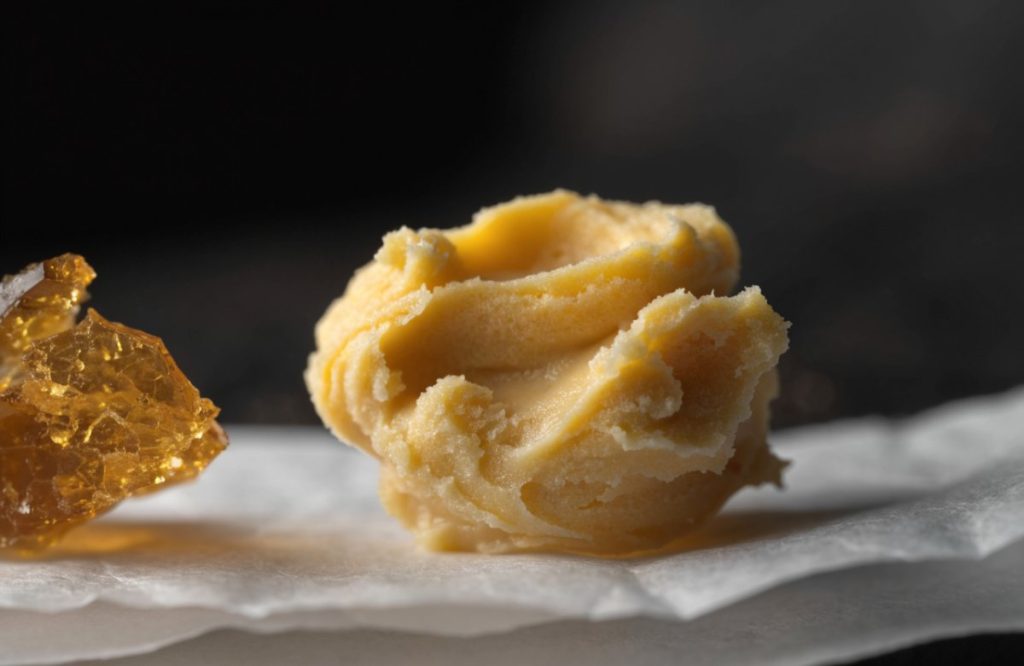
Budder is a cannabis concentrate with a soft, creamy texture like whipped butter. It is made by extracting cannabinoids and terpenes from the plant, usually with a hydrocarbon solvent, and then whipping the extract while it is purged. Budder is dabbed or added to a bowl or joint, and it is far stronger than flower.
Key takeaways
- Budder, badder and batter are the same style of concentrate; the names describe slightly different textures, not different products.
- Budder and shatter can start from the same extract. Whipping it makes budder opaque and creamy; leaving it still makes shatter glassy.
- Budder is easier to scoop and measure than shatter, which shatters into shards and gets sticky when warm.
- Making budder at home with butane is illegal in Canada and has caused serious burn injuries.
- On the Bud Cargo menu today, budder costs $20 and shatter $20 to $25.
Last updated 3 October 2026 from live stock · By the Bud Cargo team
What is budder?
Budder is a cannabis extract that has been whipped into a smooth, butter-like paste. It belongs to the same family of concentrates as shatter, wax and crumble, and like them it is made by stripping the cannabinoids and aromatic terpenes away from the plant material so that what is left is much more concentrated than the flower it came from.
What makes budder budder is texture. It is soft enough to scoop with a dab tool, holds its shape at room temperature, and ranges in colour from pale yellow to deep gold. Budder is not the same thing as cannabutter: cannabutter is ordinary kitchen butter infused with cannabis for cooking, whereas budder contains no butter at all.
How is budder made?
Budder is usually made with a closed-loop hydrocarbon extraction. A solvent such as butane is passed through cannabis to dissolve the cannabinoids and terpenes, then the solvent is purged off with gentle heat and vacuum. To make budder rather than shatter, the extract is agitated or whipped during purging, which makes the cannabinoids crystallise into fine particles and turns the oil opaque and creamy.
Why you should never make budder at home
Home extraction with butane is both dangerous and illegal. Section 12 of the Cannabis Act prohibits altering cannabis with an organic solvent, which the Act defines as any explosive or highly flammable compound, including compressed liquid hydrocarbons such as butane. The risk is real: a UC Davis burn centre treated 101 patients with butane hash oil injuries between 2007 and 2014, with burns covering on average 26.8% of the body, and three of them died (Romanowski et al., Journal of Burn Care and Research, 2017). Buy budder made in a proper lab.
Which is better, budder or shatter?
Neither is stronger by default; the difference is texture and handling. Shatter is the same kind of extract left undisturbed so it sets into a clear, brittle sheet, while budder is whipped into an opaque paste. Many people find budder easier to use, and some feel its texture keeps more aroma, while shatter tends to stay stable longer if stored well.
| Budder / badder | Shatter | Wax / crumble | Live resin | |
|---|---|---|---|---|
| Texture | Creamy, soft, whipped | Glassy, brittle, translucent | Dry, crumbly or waxy | Sappy to saucy |
| How it gets its texture | Whipped during purging | Left still to set | Whipped and dried out further | Extracted from fresh-frozen plants |
| Easy to handle? | Yes, scoops cleanly | Snaps into shards, sticky when warm | Crumbles, can be messy | Runny, needs a scoop tool |
| Main appeal | Easy dosing, rich aroma | Stability and price | Easy to sprinkle on a bowl | Strongest flavour |
| Price on our menu | $20 | $20 to $25 | Out of stock | Out of stock |
For a full breakdown of the glassy option, see our shatter guide, and for the fresh-frozen category, live resin vs distillate.
Which is better, budder or badder?
They are effectively the same product. “Budder”, “badder” and “batter” are names extractors use for whipped concentrates, and producers do not use them consistently. Some reserve “badder” or “batter” for a slightly wetter, cake-batter texture and “budder” for a firmer, smoother one, but the extraction method and the way you use them are identical.
When comparing two listings, look at the source strain, the producer and the price rather than the spelling.
Is budder the same as dabs?
Budder is one type of dab. “Dabs” is the umbrella term for any concentrate you vaporise on a hot surface, so shatter, wax, crumble, live resin and budder all count. Dabbing is the most common way to use budder, but it is not the only one.
How do you use budder?
Budder can be dabbed, vaped in a wax pen or added to flower. Because it is so concentrated, a portion about the size of a grain of rice is a normal serving, and newcomers should start smaller than that.
- Dab rig or e-rig: heat the nail or banger, let it cool to a low temperature and touch the budder to the surface. Lower temperatures keep more flavour and are less harsh.
- Wax pen: put a small amount in the chamber of a pen built for concentrates. This is the simplest option for beginners.
- Bowl or joint: spread a thin layer on top of the flower in a bowl, or roll a thin strip inside a joint. It burns more slowly than flower, so keep it away from the paper’s edge.
Our beginner’s guide to dabbing walks through rigs, temperatures and portion sizes step by step.
Is budder stronger than live resin or flower?
Budder is much stronger than flower, and roughly comparable to other concentrates such as live resin or shatter. Potency depends on the starting material and the extractor, not on the texture, so read the listing rather than assuming one style always beats another.
For scale, Canada’s legal market caps cannabis extracts at 1,000 mg of THC per container under section 101.2 of the Cannabis Regulations, a ceiling that only exists because extracts are so concentrated. Treat a small dab of budder as a strong dose.
How should you store budder?
Store budder in an airtight glass or silicone container, somewhere cool and dark. Heat, light and air break down terpenes and can change the texture; over time budder may turn grainy or “sugar up”. The fridge is fine for longer storage, but let the container warm to room temperature before opening it so condensation does not form on the budder. Our cannabis storage guide covers containers and humidity in more detail.
Where to buy budder in Canada
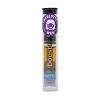
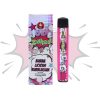
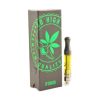
Bud Cargo has two budder strains in stock today, both $20: Unicorn Piss budder, a sativa with a bright lemon and citrus nose, and Lemon Haze budder. Both are listed in the wax and budder category.
If you prefer a glassy concentrate, 13 of the 14 shatter listings in stock are $20 to $25. Browse them in the shatter category or see every format in concentrates. Orders ship for $25 to BC, Alberta, Saskatchewan and Manitoba, $30 to the rest of Canada, and free on orders over $150. Payment is by Interac e-Transfer or credit card. Bud Cargo is a mail-order dispensary, not a provincially licensed retailer.
Frequently asked questions
What is budder weed?
Budder is a cannabis concentrate whipped into a soft, creamy texture like butter. It is made by extracting cannabinoids and terpenes from the plant and agitating the extract while it is purged.
Is budder the same as dabs?
Budder is one kind of dab. “Dabs” covers every concentrate that is vaporised on a hot surface, including shatter, wax, live resin and budder.
Which is better, budder or badder?
They are essentially the same product. Some extractors call a slightly wetter texture “badder” and a firmer one “budder”, but they are made and used the same way.
Is budder stronger than live resin?
Not necessarily. Both are concentrates, and potency depends on the starting material and the extraction rather than the texture. Check the strain and producer on each listing.
Which is better, budder or shatter?
It comes down to handling. Budder is creamy and easy to scoop; shatter is glassy, more stable in storage and often slightly cheaper. Neither is stronger by default.
Is budder the same as cannabutter?
No. Cannabutter is kitchen butter infused with cannabis for cooking. Budder is a concentrate with a butter-like texture and contains no butter.
How much does budder cost in Canada?
At Bud Cargo budder is $20 today, with two strains in stock. Shatter costs $20 to $25 for most listings.
Sources: Cannabis Act (S.C. 2018, c. 16), section 12. Cannabis Regulations (SOR/2018-144), section 101.2. Romanowski KS et al. Butane Hash Oil Burns: A 7-Year Perspective on a Growing Problem. Journal of Burn Care and Research, 2017. Prices from Bud Cargo’s live in-stock catalogue, 3 October 2026.




You must be logged in to post a comment.